
Clemmons Directory Landscape
Clemmons people directories are not one master list of residents. They are separate sources built for public contact, land ownership, voter administration, legal filings, school history, or local memory. A staff directory is best for an official work contact. The property roll lists owners and tax contacts, while a yearbook places a pupil or faculty member in a school year. The most useful starting point depends on the role being checked and the date that matters.
| Name source | People or roles shown | Record keeper | How to consult it |
|---|---|---|---|
| Village staff search | Clemmons staff, council, departments, and public services | Village of Clemmons | Free search or static roster |
| State employee directory | North Carolina agency personnel | NC.gov | Free online form |
| Deed and tax indexes | Grantors, grantees, owners, and tax contacts | Forsyth County | Free portals, phone, or counter |
| Voter data | Public fields for registered and some former voters | NCSBE | One-name lookup or weekly files |
| School yearbooks | Pupils, faculty, clubs, teams, and activities | DigitalNC and Clemmons Historical Society | Clemmons High, 1940s-1950s; West Forsyth, 1965-1971 |
| Local-history collections | Past residents, families, civic groups, and businesses | Forsyth County Public Library | 1951 Hill directory verified; Journal online since November 1997; microfilm years vary |
| Business and license tools | Entity officers, agents, and licensed professionals | Secretary of State and state boards | Free role-based searches |
Access also varies. Current public directories tend to be searchable online, but older Clemmons name sources may require a scan, microfilm reel, print volume, or librarian-assisted search. A portal no-match should therefore be treated as a prompt to try another channel, not as proof that the person had no connection to Clemmons.
Search Clemmons Staff Directory
The Village of Clemmons directory can be narrowed by category, first name, or last name. Its categories include Administration, Finance, Planning and Community Development, Public Works, Stormwater, Village Council, Village Hall, fire departments, and the Sheriff. A separate static staff roster is the practical fallback when the dynamic form does not load. Both are work-contact directories, not lists of private home details.
| Search control | Input | How it helps |
|---|---|---|
| Category | Optional dropdown | Limits results to a department or public body |
| First Name | Optional text | Narrows a known given name |
| Last Name | Optional text | Targets a family name |
| Search | Action button | Runs the selected name and category terms |
A sample Administration entry identifies Mike Gunnell as Village Manager. Comparable Clemmons directory rows use the same compact public-entry pattern.
| Entry field | What the sample shows |
|---|---|
| Department | Administration |
| Name | Mike Gunnell |
| Title | Village Manager |
| Contact action | Email Mike Gunnell |
| Work phone | 336-439-5187 |
| Private details | No home address, birth date, biography, or personal phone shown |
If a name is absent from both versions, call the relevant department or the Village main line at 336-766-7511 before assuming the person has left. Village Hall can route a public contact question, and the Clerk can handle a focused request for an existing municipal record when the directory is not enough.
North Carolina Employee Directory
The North Carolina employee directory extends a Clemmons directory search to state agencies. Its form accepts optional first, middle, and last names plus an optional agency selection. Search and Reset controls make it possible to begin with a surname, then add an agency when too many people share it. No login is required.
The state employee tool documents an official agency contact at the time shown. It should not be read as a Clemmons resident roll. A person who works for a state agency may live elsewhere, and many people in Clemmons will never appear. The separate state salary database covers active workers in the Integrated HR-Payroll system and adds title and salary data, but it serves a different purpose from the contact directory.
The official interface shows how the first, middle, last, and agency fields are combined. View the state directory source before using the captured form.
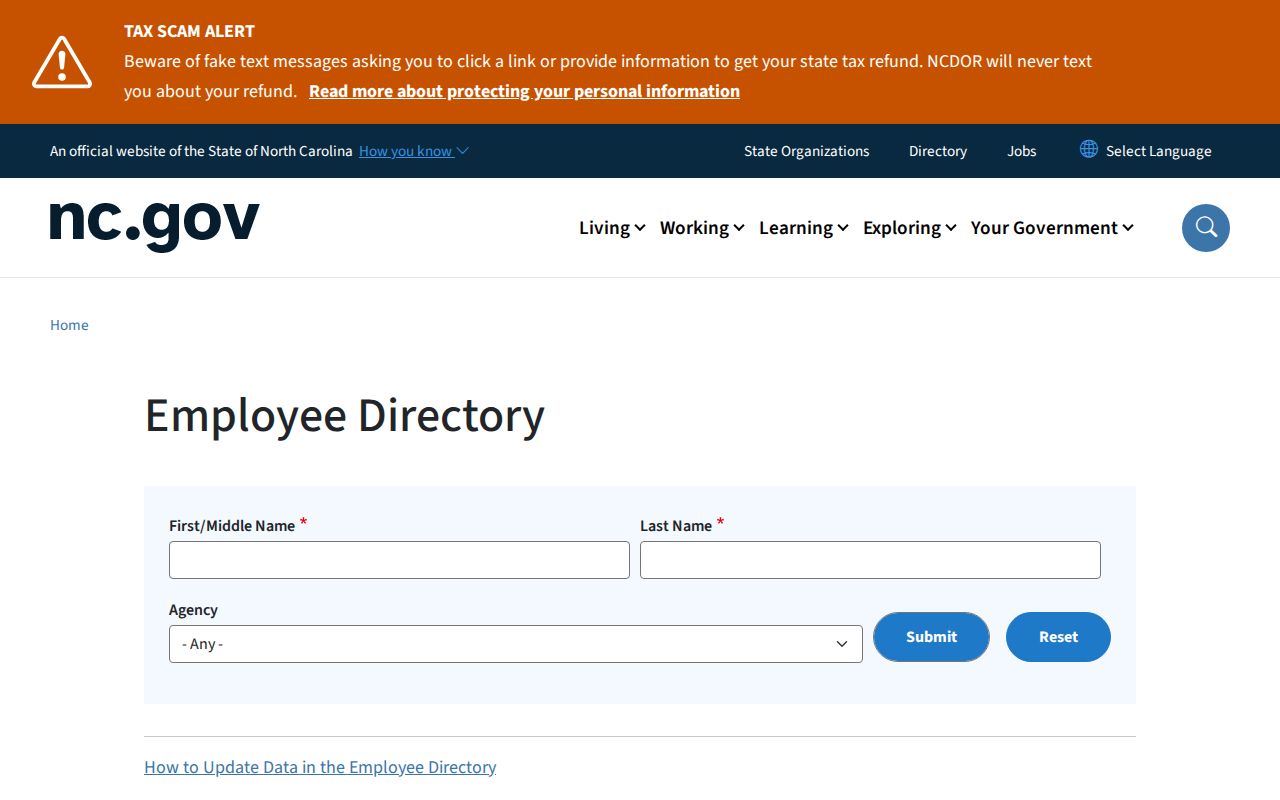
The form is most useful when an agency role is already known, because the agency filter can separate same-name public workers without implying a private connection.
Clemmons Property Name Directories
Forsyth County land tools behave like role-based people directories. The Forsyth Tax Property Portal organizes the current assessment roll around parcels and owners. The Register of Deeds index organizes names by legal party role. A grantor gives or transfers an interest, while a grantee receives one. These terms describe a recorded transaction, not who lives at the property today.
Owner mailing address and situs can differ. Situs means the physical parcel location; the mailing address is where tax correspondence goes. An LLC, estate, or out-of-area owner may be listed, while a family member or other occupant may not appear at all. The parcel identification number, or PIN, connects a tax record to GIS mapping, sales information, foreclosure rows, plats, and the deed chain.
Useful distinction: A tax roll is an ownership directory as of the assessment date, not a live household or resident list.
Online access is free, and Forsyth Tax Administration also offers counter and phone help at 336-703-2300. The deed index adds free land and miscellaneous-document searching plus real-estate images. Older or awkward searches can move to the Register of Deeds counter in Winston-Salem or to mail requests. For the access rules and copy routes behind these indexes, consult Clemmons public records.
Clemmons Voter Roll Directory
North Carolina offers two different voter name directories. The NCSBE Voter Search finds one public profile by first and last name, with optional middle initial, year of birth, and county. Selecting Forsyth helps narrow Clemmons results. The weekly registration download is the bulk directory product, with current and some former or incomplete records.
Public voter data can show status, party or unaffiliated status, registration date, county, precinct, and applicable districts. It excludes birth date, Social Security number, and driver-license number. Protected election-registration addresses are also kept out of ordinary public data. Participation history records whether a person received credit for voting and by which method; it never reveals candidate or issue choices.
Use a profile to distinguish same-name records, not to infer a person’s full life history. Files update on a schedule, and a no-match may reflect spelling, status, county, or protection rather than proving that no registration ever existed.
Clemmons Yearbook Name Directories
Digitized school books are among the strongest Clemmons people directories for reconnecting with former classmates. The Clemmons Historical Society supplied DigitalNC with Clemmons High material from the 1940s and 1950s. West Forsyth Cronus yearbooks cover 1965 through 1971. Portrait captions, class groupings, faculty pages, teams, clubs, and activities can resolve a name variant or place someone in a peer group.
The 1955 Clemmons High School yearbook is searchable, viewable page by page, and available as a download.
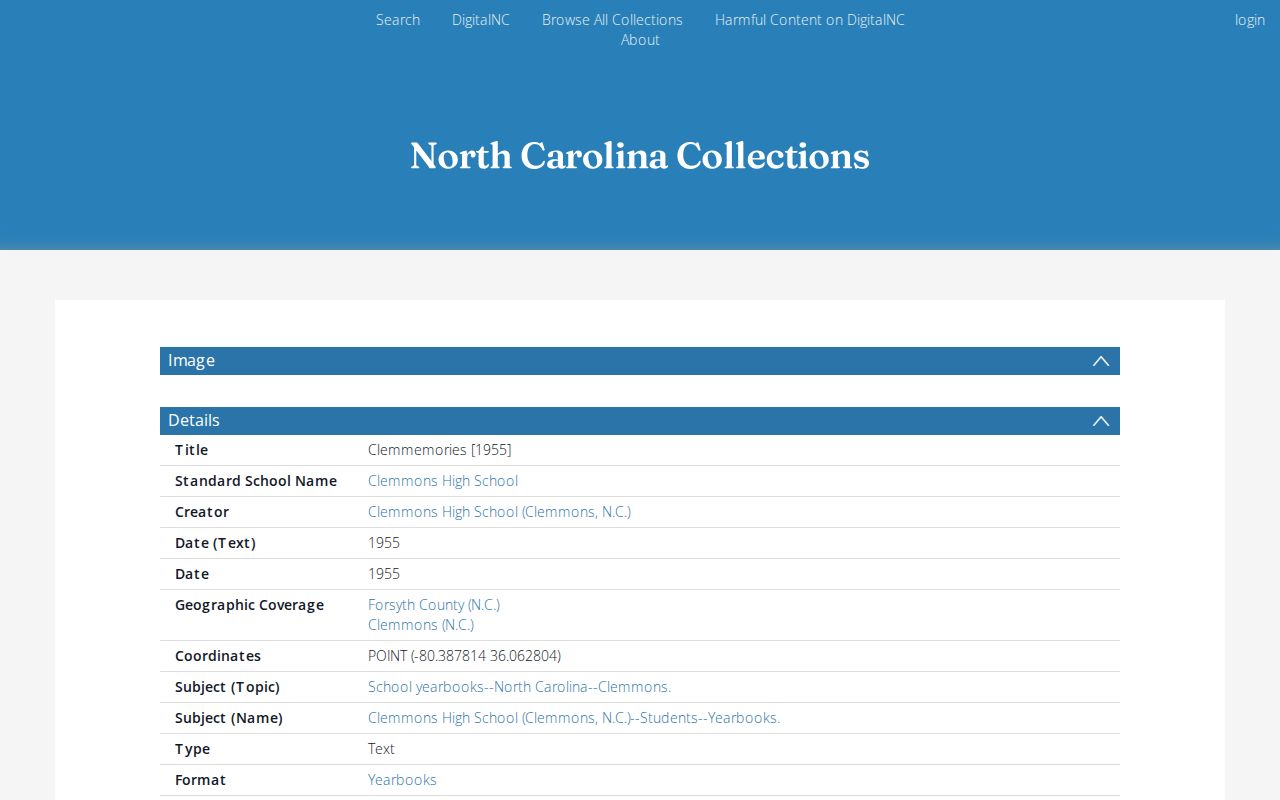
The scan preserves far more than a portrait list. Captions and activity pages connect names with teachers, clubs, teams, and classmates, which can help separate two people who shared a surname.
These education directories are historic sources. No reliable current Winston-Salem/Forsyth County Schools search-field inventory was verified, so it would be misleading to describe a present district form. Nearby college directories also should not be labeled Clemmons directories merely because a campus lies somewhere in Forsyth County.
Clemmons Hill Directory Gap
A 1951 Hill directory has verified Clemmons-area coverage, making it a firm print-era checkpoint. It can connect a name to an address or occupation as published in that edition. The full run of Clemmons city, telephone, and reverse volumes has not been confirmed, however. Reverse directories, sometimes called criss-cross directories, start with an address and lead to the listed occupant rather than starting with a surname.
The responsible fallback is the Forsyth County Public Library North Carolina Collection at 336-703-3071. Ask staff which Hill, telephone, criss-cross, obituary-index, and newspaper microfilm years actually cover Clemmons or the older place-name Clemmonsville. A precise holdings check prevents one verified year from being stretched into an invented run.
Note: A printed directory captures one publication cycle, so pair its address with a dated deed, census, newspaper, or yearbook before drawing conclusions.
Clemmons Estate Name Directories
Will and estate indexes organize people by a relationship to property after death. FamilySearch catalogs Forsyth will books from 1842 through 1932 and alphabetical devisor and devisee indexes from 1849 through 1969. A devisor is the person giving property by will. A devisee is the person receiving it. Those roles can connect a decedent, relative, heir, executor, or later owner across generations.
- Devisor
- A person who leaves real property through a will.
- Devisee
- A person named to receive that real property.
- Estate file
- The court papers that may identify the decedent, executor or administrator, heirs, assets, and valuations.
- Index
- A finding tool that points to a volume or file; it is not always the full record.
The Forsyth will catalog notes dates that precede Forsyth County’s formation in 1849, so predecessor context matters. Online catalogs and scans are the first channel. FamilySearch access rules, State Archives county record groups, the Forsyth clerk’s estate files, and physical or microfilm holdings supply the fallbacks.
Clemmons Newspaper Name Directories
The FCPL North Carolina Collection brings names together through a multi-title newspaper index, local papers on microfilm, vertical clipping files, photographs, and genealogy databases. Its index covers the Journal, Sentinel, Union Republican, Winston-Salem Chronicle, and Clemmons Journal. The Winston-Salem Journal is available online from November 1997 forward, while some microfilm holdings extend more than a century.
The collection’s official page introduces the available genealogy tools, newspapers, images, and local-history help. Open the North Carolina Collection source before reviewing the captured page.
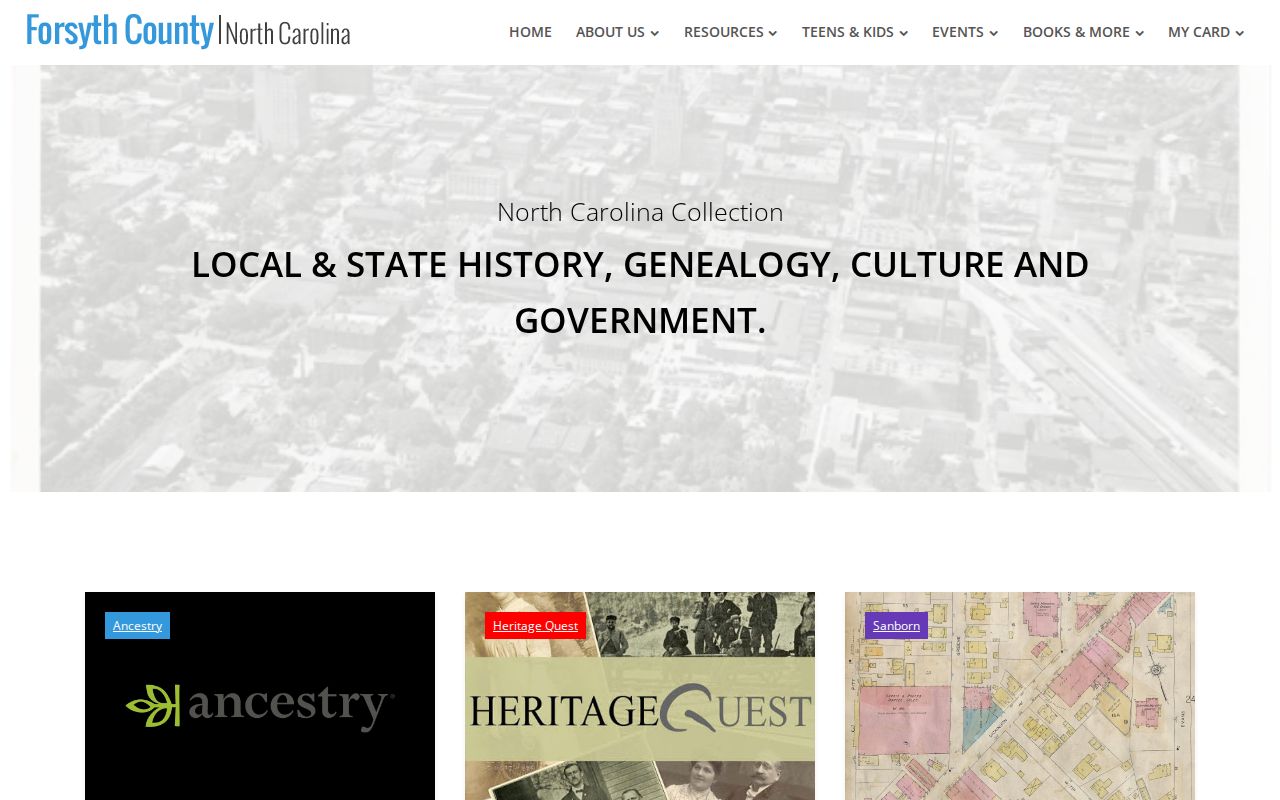
The range of tools shown explains why a newspaper name search can move from an online index to a clipping file, database, photograph collection, or microfilm reel without leaving the library system.
Newspapers work as event directories rather than full resident lists. Obituaries can connect kin; club and school notices can place a person in a group; business stories can establish a public role. Search both Clemmons and Clemmonsville, then test punctuation, double surnames, initials, and alternate spellings.
Clemmons Business Role Directories
The North Carolina Secretary of State business search is a filing directory. It can search an organization name or a person’s last, first, and middle names, along with search-type controls. Formation filings may identify an entity’s public officers, registered agent, or other filed role. Assumed names, UCC records, charities, federal liens, and new company or change reports are separate official trails.
Professional directories are split among North Carolina boards. NC BOLD and the state service list identify the regulator, after which the relevant board may show a license number, name, status, issue or expiration dates, location, and public discipline. Because each board publishes its own controls, no single field set should be promised for every profession.
The Lewisville-Clemmons Chamber’s annual guide adds voluntary member and business listings. It is useful evidence of a published association, not a complete legal roll. Likewise, Village permits can name project applicants or representatives when released, but Clemmons keeps only stormwater, sign, and driveway permit records; Winston-Salem/Forsyth handles building and inspection work for the Village.
Clemmons 1960 Community Directory
The 1960 Clemmons Community Development Council Progress Book crosses the usual directory boundaries. Its pages name people and groups connected with homes, businesses, the fire department, schools, Scouts, sports, civic clubs, garden and home-demonstration clubs, and Baptist, AME Zion, Moravian, and Methodist congregations. Photographs add another way to connect a printed name with a place or group.
This unusual community source can bridge formal records and social life. A family might appear in a church or club entry, then in a yearbook, deed, will index, or newspaper item. The book is more defensible than assuming a private congregation, neighborhood, alumni, union, or fraternal roster is open. No authoritative public master directory for those private groups was verified.
Note: Membership in the Progress Book reflects the groups and activities its compilers documented in 1960, not every person then living in Clemmons.
Historic Clemmons Directory Timeline
Clemmons historical directories sit within a longer record-keeping shift. Forsyth County formed in 1849. The Register of Deeds says some instruments date to that formation, yet official Forsyth recording did not begin until 1913. Its records moved from handwriting to typing, then microfilm and computer indexes. That sequence should not be flattened into a claim that every old name is online.
- 1849-1904: Forsyth land records were copied by hand, with early county name trails tied to volume and index work.
- 1904-1929: Typed records replaced the handwritten period, while paper books remained central.
- 1951: The verified Hill directory gives Clemmons-area print coverage.
- 1954-1965: Microfilming began, vital indexes were integrated in 1962, and computerized indexing started in 1965.
- 1960s onward: The Progress Book, library service, West Forsyth yearbooks, and later digital collections widened the available name trails.
Today, the online deed, tax, voter, staff, and state employee directories serve current research, while the library, DigitalNC, FamilySearch, the State Archives, and office counters reach back. Printed evidence should always be dated. When the precise city-directory year is unknown, ask the collection holder instead of treating a digital gap as a missing person.